
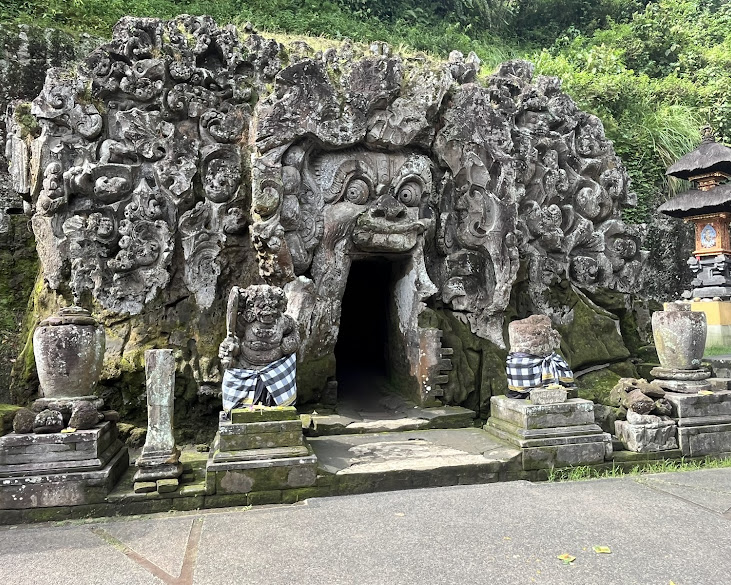
Elephant Cave is an ancient man-made cave that served as a place of worship. It is located in Bedulu Village, Blahbatuh District, Gianyar Regency, Bali.
The discovery of the Elephant Cave began with a report from a Dutch East Indies official, LC. Heyting in 1923 who found a statue of Ganesha, Trilingga and Hariti statues to the Dutch East Indies government. This was followed up by Dr. WF. Stutterheim to conduct further research in 1925. In 1950 the Indonesian Archaeological Service through the sections of ancient buildings in Bali led by J.L. Krijgman conducted research and excavations from 1954 to 1979 and discovered an ancient bathing place with 6 statues of women (nymphs) with water fountains on their chests and until now its existence can be believed to provide aura purification vibrations for visitors.
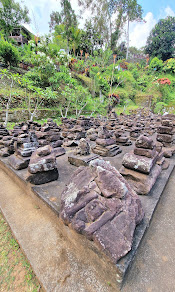
In 1931, Mr. Conrat Spies also discovered a fairly important relic in the Tukad Pangkung complex in the form of a three-branched stupa carved into a collapsed stone wall lying at the bottom of the Pangkung River.
Since 1950, after the Indonesian Antiquities Agency opened its Bali branch office in Gianyar under the leadership of J.C. Krijgsman, research into the archaeological remains at Elephant Cave has received special attention. This was demonstrated in 1951/1952 by excavations in the courtyard in front of the cave’s entrance. These excavations uncovered ancient rectangular foundations, with the cave’s front wall as one of its long sides.
That same year, cracks were also discovered in the cave ceiling caused by the roots of a frangipani tree growing on the cliff to the right of the cave entrance. While clearing the soil and roots in the western part of the cave, two stone fragments were discovered: the first part of a giant’s head above the cave entrance, and the second part of a carved section of the eastern wall. A stone sword, part of a giant statue in front of the cave, was also found.

Leave a comment