
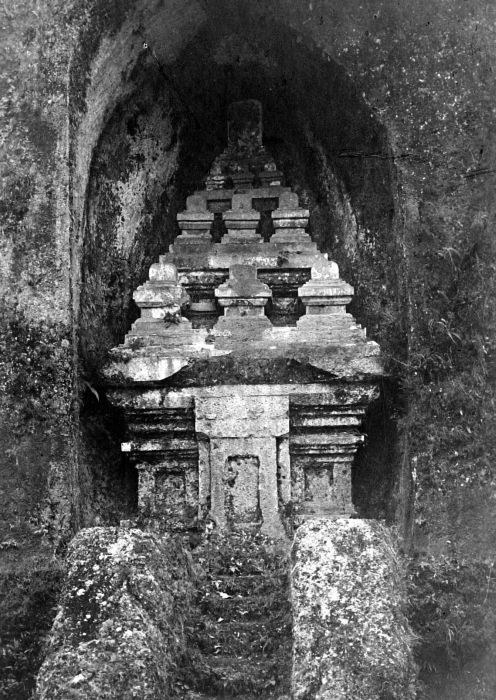
Gunung Kawi Temple or Gunung Kawi Cliff Temple is a protected archaeological site in Bali, located on the Pakerisan River, Penaka Hamlet, Tampaksiring Village, Tampaksiring District, Gianyar Regency, Bali Province, Indonesia. 180 This temple is very unique because usually temples are in the form of intact rocks made of red brick or mountain stone, but this temple is not like that but is carved on the rock cliff wall on the river bank. The name Gunung Kawi itself is said to come from the words Gunung and Kawi. Gunung means Mountain or Mountains and Kawi means Carving So Gunung Kawi Temple means a temple carved on a mountain. This temple is located about 40 kilometers from Denpasar City with a journey of about 1 hour by car or motorbike. While from Gianyar City it is about 21 kilometers or about half an hour’s journey. If you do not bring a private vehicle, from Denpasar or Gianyar tourists can use taxi services, tourist buses, or travel agent services.
- HISTORY of Gunung Kawi
This temple was built around the 11th century AD during the reign of King Udayana and the reign of Anak Wungsu. King Udayana was one of the famous kings in Bali from the Warmadewa Dynasty. Through his marriage to a Javanese princess named Gunapriya Dharma Patni, he had children, Erlangga and Anak Wungsu. When he grew up, Erlangga became king in East Java, while Anak Wungsu ruled in Bali. It is believed that the Tebing Kawi temple was built during this period. One archaeological evidence to support this assumption is the inscription above the pseudo-door in Kediri script that reads “haji lumah ing jalu,” meaning the king who is (symbolically) entombed in Jalu. The king in question is King Udayana. Meanwhile, the word jalu, the term for the spur (weapon) of a rooster, can also be associated with the keris or pakerisan. The name of the Pakerisan River or Tukad Pakerisan is now known as the river that divides the two cliffs of the Kawi Temple. This temple was rediscovered by Dutch researchers around 1920.
- Other History
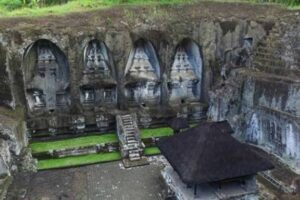
According to local folklore, Gunung Kawi Temple was built by a powerful figure named Kebo Iwa. Using his supernatural powers, Kebo Iwa is said to have carved his sharp, strong claws into the rock wall of the Pakerisan River. The rock appears to have been finely and expertly carved, forming a beautiful cluster of temple walls. The work, which would have taken many people a relatively long time, was reportedly completed by Kebo Iwa in a single day and a night.
- Uniqueness
Gunung Kawi Temple has approximately 315 steps along the banks of the Pakerisan River. The serene atmosphere, imbued by the lush trees along the riverbank and the gurgling water of this sacred river in Bali, creates a sense of being welcomed by a natural symphony. The steps leading to Gunung Kawi Temple are made of tuff and framed by stone walls.
Upon arriving at the temple complex, visitors will encounter two groups of temples separated by the Pakerisan River. The first temple is located on the west side of the river, facing east, with four temples. The second temple is located on the east side of the river, facing west, with five temples. The western temple complex also features a bathing pool and fountain. Witnessing these two temple complexes, visitors will be awed by the sight of the neatly carved rock walls forming curved chambers that house the temples. These temples were deliberately built within a basin to protect them from erosion.

Leave a comment